The Best Time for a Champagne Day Trip from Paris
October is the best month overall, with autumn colour in the vineyards, fewer visitors after the September peak and enough daylight for a full day in Champagne. Compare all 12 months below and check your dates against the harvest.
Champagne is a two-hour drive east of Paris, and the day trip runs all year. The cellars never close for the season, so no month is a write-off. What changes is everything above ground: whether the vines are bare or in leaf, whether the tasting can happen outside, how long the light lasts, how busy the villages are, and whether the growers are pouring or picking.
Check Availability
Check your date
The harvest moves by up to a month between years, so a specific date tells you more than a month does. Pick yours and this shows how likely the picking is, what the weather usually does, and how much light you get.
Autumn colour on the slopes in the second half of the month, the picking over in most years, and the crowds easing.
- HarvestUnlikelyNo vintage on record has picked in October
- Weather15°C average high, 10 days of rainLong-term average for October, not a forecast
- DaylightSunset 18:55Enough light for the vineyard stops
Champagne Day Trip from Paris with 8 Tastings & Lunch. $372, 1,737 reviews.
Why October is our pick
October has the best balance of the four things that actually vary: scenery, crowds, daylight and access.
The vine leaves turn in the second half of October, which is the one moment in the year when the slopes above Reims and Épernay are gold and copper instead of green or bare. The picking is over by the start of the month in most years, so the family growers are back in their tasting rooms instead of out in the rows. Visitor pressure drops away from September’s annual high. And the sun still sets around 18:55 in the middle of the month, so a day that leaves Paris in the morning gets its vineyard stops in daylight and the drive home through the vines while there is still something to see.
What you give up is warmth and a little dryness. October averages a high of 15°C, 59°F, against September’s 20°C, 68°F, and it collects around ten days of rain in the month against September’s eight. Neither is enough to move a trip.
If weather is your single priority, September has the edge instead. If long evenings and green vineyards matter more, go in June.
What the vineyards look like, month by month
Most of what makes one month feel different from another is the vine itself, and it keeps a fairly reliable calendar.
January to March. Bare stems and wire. This is pruning season, and if you visit you will see growers working the rows in the cold, one vine at a time, shaping next autumn’s crop. It is genuinely interesting when a guide explains it, and the only time of year you can watch it. Villages are quiet, restaurants are calm, and the day is short.
April. Budbreak, almost always around the middle of the month. The slopes shift from brown to a faint green haze over a couple of weeks. Daylight gains more in April than in any other month, and sunset moves out past 20:30.
May. Leaves fill in and the vineyards go properly green. Highs reach about 19°C, 66°F, which makes it the first month a terrace lunch is reliably pleasant.
June. Flowering, in the second half of the month, and the longest days of the year — the sun does not set until nearly 22:00. The vineyards are at their greenest. It is also one of the two busiest months in the region.
July and August. The warmest months, both averaging highs around 25°C, 77°F, and among the driest. The grapes soften and change colour in August, so by the end of the month the bunches look like the ones on the label. Cellars at 10°C are a real relief on a hot day, and you will want a jacket for them.
September. Harvest, which has a section of its own below.
October. The last grapes come in at the start of the month if they are not already in, and the leaves turn in the second half. This is the best the vineyards look all year, and the villages have gone quiet again.
November and December. The leaves drop in early November and the vines go back to bare wire. Sunset is at 17:04 in mid-November and 16:46 in mid-December, so the vineyard stops on an itinerary happen in flat light or after dark. The compensation is indoors. Reims runs one of the largest Christmas markets in France, around 150 chalets on the Promenades near the station; the 2025 edition ran from 26 November to 28 December, so check the current year’s dates. Épernay’s Habits de Lumière lights up the Avenue de Champagne over one December weekend, though it is an evening event and a day trip back to Paris will not catch it.
Here is the same year in numbers. Weather figures are long-term Météo-France averages for the Champagne vineyards; a day with rain is one that collected a millimetre or more, which says nothing about whether it fell at breakfast or across the whole afternoon.
| Month | Typical high | Days with rain | Sunset | Hotels full | Good for |
|---|---|---|---|---|---|
| January | 6°C / 42°F | 12 | 17:12 | 40% | Pruning, quiet villages, cellars |
| February | 7°C / 44°F | 10 | 18:02 | 45% | The quietest half of winter |
| March | 11°C / 52°F | 10 | 18:48 | 53% | First green, still low season |
| April | 15°C / 59°F | 9 | 20:35 | 60% | Budbreak, and long evenings arriving |
| May | 19°C / 66°F | 10 | 21:19 | 66% | Green vineyards, first terrace lunches |
| June | 22°C / 72°F | 10 | 21:51 | 75% | Flowering and the longest days |
| July | 25°C / 77°F | 8 | 21:45 | 67% | Warmth, and cool cellars to escape into |
| August | 25°C / 76°F | 8 | 21:02 | 63% | Ripening grapes, quieter than June |
| September | 20°C / 68°F | 8 | 19:59 | 75% | Harvest, and the driest weather |
| October | 15°C / 59°F | 10 | 18:55 | 65% | Autumn colour on the slopes |
| November | 10°C / 49°F | 11 | 17:04 | 55% | Cellars, cathedral, Christmas market |
| December | 6°C / 44°F | 13 | 16:46 | 52% | The festive season, indoors |
September: the harvest month
September is the most exciting time to be in Champagne and the most complicated to book.
Every grape in the appellation is picked by hand, so for two or three weeks the villages fill with seasonal workers, the presses run through the night and the whole region is visibly at work. If you want to see how Champagne is made rather than hear about it, this is the fortnight.
The weather helps. September gets fewer days of rain than May or June, and highs still average 20°C, 68°F. In the vineyards around Épernay it is the driest month of the year.
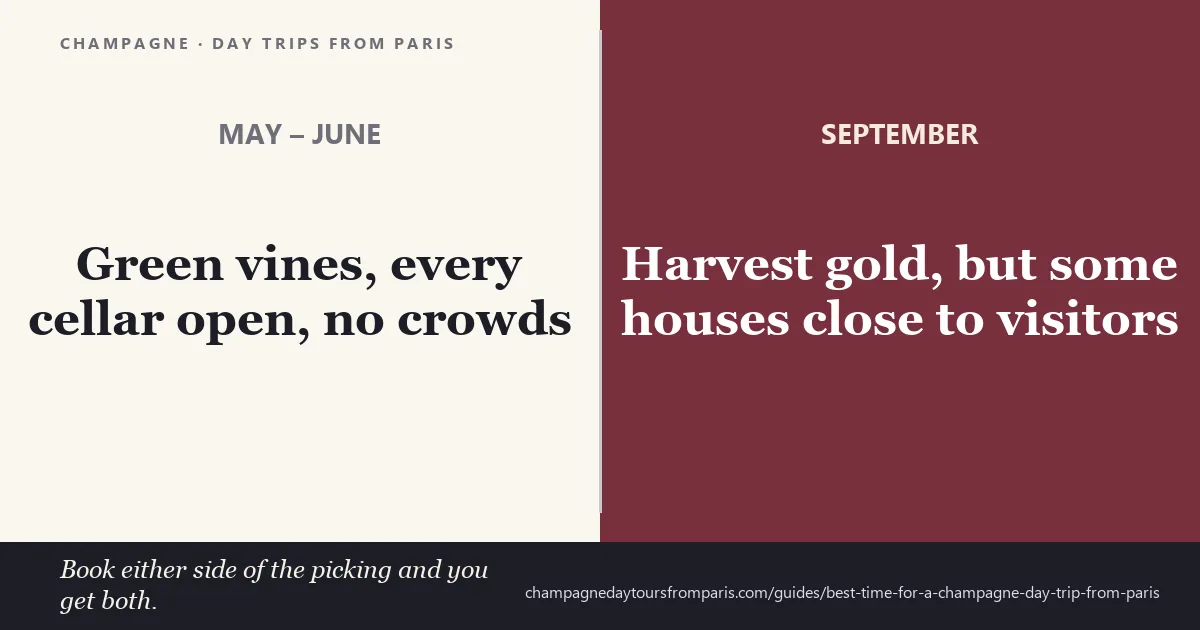
Two things to know before you fix on it. September is often called shoulder season, but Champagne behaves differently: regional hotel occupancy reaches its annual high in September, so do not expect it to be quiet. And some small growers pause tastings while they pick, because the person who pours is the person out in the vines. The big houses in Reims and Épernay keep their cellar visits running throughout.
When the harvest happens, and what it changes
The date moves a long way from year to year, which is why it is worth checking instead of assuming. Each vintage the Comité Champagne publishes an opening date for every village once the grapes are ready, and picking then takes one to three weeks depending on the estate.
For Reims, across the six vintages with published dates still available:
| Vintage | Picking opened | Latest it could have run to |
|---|---|---|
| 2019 | 11 September | 2 October |
| 2020 | 24 August | 14 September |
| 2021 | 17 September | 8 October |
| 2022 | 30 August | 20 September |
| 2023 | 7 September | 28 September |
| 2026 | 15 August | 5 September |
That is a spread of thirty-three days between the earliest and latest start, with no trend to it: 2026 opened earlier than any vintage on the list, and 2021, five years before, opened latest. The third column applies the three-week upper end and is an estimate, not a published date. The 2024 and 2025 sheets for the Marne are not available.
The practical upshot: if your dates fall anywhere between mid-August and early October, use the date check above instead of guessing from the month.
What the picking actually closes is narrower than it sounds. The grande marque cellars keep taking visitors. Family growers are the ones that stop, and often at short notice. This is one period when a guided tour has a practical advantage: if a small producer becomes unavailable, the operator can usually substitute another stop, whereas a self-assembled day simply loses it.
Which day trip suits which month
The day has the same shape all year: two hours east, a grande marque cellar, a family grower or cooperative, lunch, and two hours back through the vines. What varies is how much of it depends on being outdoors.
April to October: the full day with lunch
The 8-tastings-and-lunch day includes a tasting masterclass out in the vines when the weather allows, which is the one part of any of these itineraries that needs the season on its side. It is also the most-booked Champagne day trip on GetYourGuide. From $372, 1,737 reviews. Our breakdown.
November to March: the cellar-focused day
With bare vines and sunset before 17:15, a day built around cellars, Reims cathedral and the tasting rooms makes more sense than one built around the view. The small-group day with six tastings does exactly that, and is the cheapest of the small-group options. From $263, 367 reviews.
Any month, if you want Épernay as well
The day with the cathedral and the Avenue de Champagne adds Épernay's grand houses to the Reims stop. It is the priciest of the three and the one least affected by the calendar. From $400, 703 reviews.
How much the weather actually matters
Less than you would expect, because most of the day is under a roof or under the chalk.
The cellars sit at about 10°C, 45°F, damp, all year round, and that stable temperature is the whole point of them. Cellar visits therefore change very little with the season, and people who arrive in August in shorts spend the tour cold. Take a jacket whatever the forecast says.
Lunch is indoors, though a terrace is a summer pleasure. Reims cathedral is indoors and open all year. That leaves two things the weather can move: the vineyard viewpoint, which in heavy rain becomes a photo stop from the van, and the tasting out among the vines, which several operators state runs subject to conditions. Between November and March, assume it happens inside.
So rain is a reason to pick a different departure rather than a different date. Limited daylight is the bigger drawback: in December the sun is down by 16:46, and the drive back through the vineyards happens in the dark.
How busy it gets
The only monthly measure published for the region is hotel occupancy across the Marne, and it runs from 40% in January to 75% in September, averaged over 2022 to 2025. June is within half a point of September at 75%, October sits at 65%, and July and August come in lower at 67% and 63%.
Two things follow. September has the highest regional hotel occupancy in the available data, which suggests noticeably more visitor pressure than its shoulder-season label implies. And the summer peak belongs to June, not July or August — August in particular is quieter here than the Paris season would lead you to expect.
Treat all of that as a guide to relative pressure, not a headcount. It measures hotel rooms sold across a whole department, so it misses day trippers who sleep in Paris, which is most people reading this, and it cannot tell you how many people will be in the cellar with you.
Which day of the week, and how far ahead to book
Weekends are busier at the big houses, and the roads out of Paris are heavier on Friday and Sunday evenings. Tuesday to Thursday means smaller groups at the cellar visits and an easier drive both ways. Some family growers close on Sundays, so trips built around them tend towards weekdays anyway.
On lead time, a guided day is far more forgiving than doing it yourself. Booking a cellar visit directly at a grande marque can mean planning months ahead for a summer weekend; the day trips here usually need days instead of months. For June to October, booking ahead is sensible if your Paris dates are fixed, and tours with free cancellation give you some flexibility if your plans change.
For what the day itself involves, read what happens hour by hour, or compare the full list of Champagne day tours from Paris.
For a closer comparison of late-autumn dates, read Champagne tours from Paris in October and November, including published 2026 house schedules and indoor-focused tour choices.
Questions people ask about timing
Select a question to see the answer.
When is the Champagne harvest?
Late August to late September, and it moves a long way between years. Across the six vintages with published dates, picking at Reims opened as early as 15 August in 2026 and as late as 17 September in 2021, and it then takes one to three weeks depending on the estate. The date for a given year is only announced a few weeks ahead, so check it before you commit to a month.
Is September a good time to visit Champagne?
Yes, and it is the most likely time to catch the picking: in all six vintages with published dates, some part of the harvest fell in September, and the whole region is visibly at work. It also gets fewer days of rain than May or June. The two catches are that regional hotels are at their fullest in September, so it is not the quiet shoulder month it is often described as, and that some small growers pause their tastings while they pick.
When do the Champagne vineyards turn autumn colours?
The vine leaves colour through the second half of October and drop in early November. That makes the last fortnight of October the best-looking time of year on the slopes above Reims and Epernay, and it falls after the harvest has finished in almost every year.
What is the weather like in Champagne in October?
Mild, and only a little wetter than September: a typical high of 15C, 59F, and around ten days of rain across the month. Sunset is about 18:55 in the middle of October, so a day trip that leaves Paris in the morning still gets its vineyard stops and the drive home in daylight.
Do Champagne houses close during the harvest?
The large houses in Reims and Epernay generally keep their cellar visits running throughout. Small family growers are the ones that stop, because the people who pour the tastings are the same people picking the grapes. That is the practical argument for a guided day during the picking weeks: an operator can usually substitute another producer, whereas a self-made itinerary simply loses the stop.
What is the quietest month to visit Champagne?
January, on the only monthly measure published for the region. Hotel occupancy across the Marne averages 40 percent in January against 75 percent in September, with February next quietest at 45 percent. Read it as relative pressure, not a headcount: it counts hotel rooms sold across a whole department and does not see day trippers who sleep in Paris.
How cold are the Champagne cellars?
About 10C, 45F, and damp, all year round. The steady temperature is what lets the bottles age, and it is also why cellar visits change very little with the season. Take a jacket even in August, when people regularly turn up in shorts and spend the tour cold.
Is November a good time to visit Champagne?
It depends what you came for. The leaves have dropped by early November, the sun sets just after 17:00 and it is one of the wetter months, so a vineyard-focused day loses most of its point. The cellars, the lunch and Reims cathedral are unaffected, hotels are far quieter than in September, and Reims opens one of the largest Christmas markets in France towards the end of the month.
How we know
- Rain, temperature and wet days
- Météo-France station normals for 1991-2020, from the published climate sheets. The headline station is Mailly-Champagne (51338001), a grand cru village on the Montagne de Reims and the nearest station to the vineyards these day trips visit. Every figure is cross-checked against Chouilly (51153001), beside Épernay on the Côte des Blancs. Reims itself has no published climate sheet, which is why the figures come from the vineyards rather than the city. Where the two stations disagree, the page quotes the weaker of the two.
- What the vines are doing each month
- The vine calendar — budbreak in mid-April, flowering in the second half of June, the grapes colouring in August, the leaves turning in the second half of October and dropping in early November — is the published growing calendar of the Union des Maisons de Champagne. Nature moves it: budbreak is the most reliable of those dates and ripeness the least.
- How busy the region is
- Monthly hotel occupancy for the Marne, INSEE series 010598981, averaged over 2022, 2023, 2024 and 2025.
- Harvest dates
- The Comité Champagne publishes an opening date for every village once each vintage is ready. Only the current year stays online, so the earlier vintages here were read from Internet Archive captures of the same file. The 2024 and 2025 sheets for the Marne were not captured and are missing from the table.
- Sunset and daylight
- Computed for Reims with the standard NOAA solar position algorithm, in French civil time with summer time applied. Accurate to a few minutes, which is why nothing here is quoted more finely than that.
- The forecast in the date check
- Open-Meteo, which blends several national forecast models instead of serving one. It is a forecast, and the card labels it as one. Not linked: every off-site link costs attention, and the four above are the ones worth spending it on.
- Events and opening dates
- Christmas market and festival dates come from the organisers and are given for the edition stated. They move every year, so the page says which year it is quoting and tells you to check the current one.
- Prices, ratings and review counts
- The live GetYourGuide listings, last read 2026-09-06.
What these numbers cannot tell you
- A thirty-year average is not a forecast. September having fewer wet days on average says nothing about the September you have booked, and the two stations do not fully agree: September is the driest month of the year at Chouilly, but at Mailly-Champagne it sits just behind July and August.
- A wet day is a day with a millimetre or more of rain. It does not count how long the rain lasted, how heavy it was, or whether the afternoon stayed dry, and a month with one storm and a month with three drizzling weeks can total the same rainfall.
- Hotel occupancy is a proxy for pressure across a whole department. It does not count day trippers who sleep in Paris, which is exactly who reads this page, and it cannot tell you how many people will be in the cellar with you.
- Six vintages is a small sample and two more are missing. The spread in opening dates is real; a trend inside it would not be.
- We do not have per-date fares, so nothing here says which month is cheapest to fly or book into.
- Which producers a given operator visits, and which of them stay open through the picking, is a question only the booking calendar answers. Where this page cannot tell you, it says so and sends you to check.
Ready for a Day in the Vines?
Rated 4.8/5 by more than 1,700 travellers. Paris hotel pick-up, eight or more tastings, and a Champagne-paired French lunch. Free cancellation up to 24 hours before.
Check Availability & Book